
Women Health Andrology
Understanding ICSI Success Rates by Age Group: 2026 Trends
Overview
Being a specialised form of IVF treatment, intracytoplasmic sperm injection (ICSI) is often recommended by fertility experts when male infertility is a significant concern. ICSI treatment success rates are believed to be higher than regular IVF treatment for couples with unexplained infertility and recurrent IVF failures. However, like any other medical treatment, ICSI also has its limitations. One main factor that influences the ICSI success rate is the age of the mother. Let us dive into detail about how age influences ICSI success rates and ways to improve fertility treatment outcomes.
What is ICSI?
ICSI is a special procedure performed along with IVF (in vitro fertilization) to increase the successful fertilization of the egg. It is an additional step in the IVF process that may be recommended by your doctor under certain circumstances.
For successful fertilization, the sperm (விந்து) should travel to the egg (கருமுட்டை) and penetrate through the outer layer into the cytoplasm, the inner part of the egg. In the ICSI treatment, among the thousands of sperm, your ICSI specialist filters and selects one healthy sperm to use for fertilisation (கருத்தரித்தல்). This avoids issues like reduced sperm motility and difficulty penetrating the egg.
IVF and ICSI: What’s the Difference?
ICSI stands out from a standard IVF process by one additional step. In a standard IVF treatment, thousands of sperm are placed along with the egg in a petri dish in the lab. Among them, one sperm swims and reaches the cytoplasm of the egg, thereby fertilizing it. Whereas in ICSI, specialists select one healthy sperm and manually inject it into the centre of the egg for fertilization.
This targeted approach helps significantly in increasing the chances of successful fertilization and pregnancy, and is one of the big reasons for ICSI’s higher success percentage. Let us walk you through the step-by-step process of ICSI treatment to better understand the process.
- Assessment: The couple’s health status is assessed thoroughly, and diagnostic tests may be performed if necessary.
- Stimulation: The next step is stimulating the ovaries to produce multiple mature eggs to reduce errors.
- Retrieval: The mature eggs are then retrieved from the ovaries through a minimally invasive procedure under sedation.
- Sperm retrieval: The partner’s sperm is collected and processed to separate the sperm from the semen.
- Insemination: An embryologist selects a single healthy, motile sperm and directly injects it into the cytoplasm of a mature egg to achieve fertilization. This is a key step that distinguishes ICSI from conventional IVF.
- Embryo development: The fertilized egg is carefully monitored to assess its development.
- Embryo transfer: The developed embryo is then transferred back to the uterus with the use of a catheter for implantation.
- Follow-up: A blood test may be performed a few days after transfer to confirm pregnancy.
When is ICSI Recommended Instead of IVF?
Although the ICSI success rate is higher than the standard IVF success rate, the American Society for Reproductive Medicine (ASRM) suggests not recommending the use of ICSI for patients without male infertility factors.
The primary goal of reproductive treatments is live birth; however, ICSI is highly linked with increased chances of fertilization. Several studies have found that using ICSI significantly increases fertilization outcomes but does not improve live birth rate. Trusting your doctor to determine whether IVF with ICSI is necessary is often the best approach.
The common scenarios where ICSI is recommended by your fertility specialist are:
- Reduced sperm count (குறைந்த விந்தணு எண்ணிக்கை)
- Poor sperm motility
- Abnormal sperm morphology
- Inability of the sperm to penetrate the egg
- Previous IVF failures
- Usage of IVM (in vitro matured) eggs
- Usage of frozen eggs
- Unexplained infertility
Does Age Affect Your ICSI Journey?
By directly injecting a single sperm into the cytoplasm of the egg, ICSI can increase the likelihood of successful fertilization. However, like all other fertility treatments, ICSI does not guarantee 100% success. The success of ICSI is often measured by the percentage of eggs that are fertilized in the lab, along with clinical pregnancy and live birth rates. However, the Alpha-ESHRE suggests that each clinic should set its own benchmark to define ICSI success rate based on their own experiences and practices.
- Fertilization rate: The percentage of mature eggs that are successfully fertilized after injection of a single sperm is the fertilization rate. With ICSI, about 50-80% of mature eggs are fertilized.
- Clinical pregnancy rate: This shows the number of embryo transfers that resulted in a confirmed pregnancy.
- Live birth rate: This refers to the percentage of live births achieved per fertility treatment cycle.
Although several factors can influence ICSI outcomes, maternal age remains a primary factor with significant impact on the above parameters that determine ICSI success.
ICSI Success Rate by Age Group: What 2026 Trends Show
Since egg quality and ovarian reserve are significantly modified by age, the success rate of ICSI varies between age groups. Women younger than 35 years of age have a higher ICSI treatment success rate, as they are likely to have high-quality eggs. The live birth rate per cycle is also observed to be highest for young women. The ICSI success rate classified by age group is listed below.
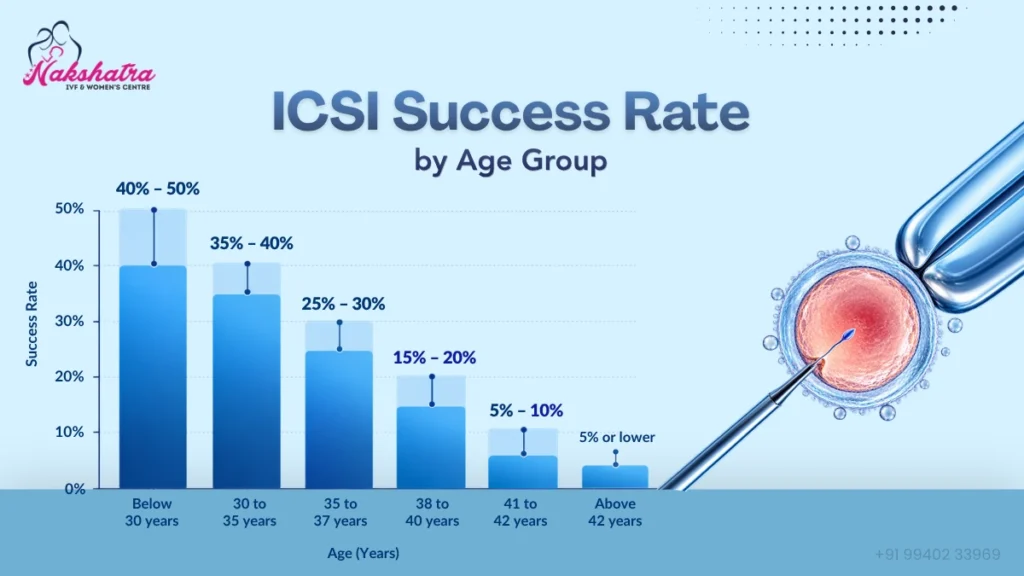
- Below 30 years: Young women of this group have high-quality eggs and good egg reserve, resulting in the best overall prognosis and a greater ICSI success rate. Pregnancy rates commonly are about 40% to 50% every cycle among women under 30 years.
- Between 30 to 35 years: Women of this age are still very fertile but with a minor drop in the quality of the egg. The treatment success rate is about 35% to 40% per cycle.
- Between 35 to 37 years: There is a mild decline in pregnancy rates among women in this age group, with success rates per cycle ranging from 25% to 30%, primarily due to a decline in egg quality.
- Between 38 to 40 years: A significant decline can be observed, with success rates ranging between 15% and 20% per cycle. The embryo becomes more prone to miscarriages and chromosomal abnormalities; hence, genetic testing is generally recommended.
- Between 41 and 42 years: Women of this age group have lower embryo quality, which greatly reduces the success rates to 5% to 10% per cycle.
- Above 42 years: There is a significant decline to about 5% or lower success rates per cycle. Sometimes, donor eggs are suggested to be a better option for this age category.
Myth vs Fact
Myth: ICSI guarantees pregnancy and live birth for women of all ages.
Fact: ICSI does not improve pregnancy and live birth chances, especially with advancing age. The success rate depends greatly on the egg quality, health of the sperm, and uterus.
Chances of Success with Multiple Cycles
The cumulative ICSI-IVF success rate increases after several cycles are completed. It’s normal for IVF not to work the first time. Research shows that your chances improve with each cycle, and by the third attempt, success rates can almost double.
The success rate after the first cycle is about 30%, and increases to about 50% after the second attempt. The chances for success increase with each consecutive cycle. It is observed that it may increase to about 70% after the third cycle. However, taking the first step and beginning treatment is a big decision, so speaking with experienced fertility specialists in Chennai can give you clarity and help you make informed decisions.
ICSI Outcomes in Women Over 40
Aging causes changes in a woman’s fertility status by diminishing the ovarian reserve, reducing egg quality, and uterine receptivity. The hormonal shifts that occur with age are also responsible for this change. The decline in egg quality also increases the risk for chromosomal abnormalities and miscarriages.
But with the support of a trusted fertility centre, you can consider other options such as using donor eggs and hormonal treatment (that helps prepare the uterus). Research has also noted that using additional embryos that are cryopreserved can help increase the overall pregnancy success rate. Another study among women over 40 years found that planning the time interval between egg retrieval and sperm injection improves embryological and clinical outcomes in ICSI cycles. A time interval between 3 and 4 hours showed better outcomes.
Takeaway
ICSI is a valuable technique that significantly helps several couples with male factor infertility and unexplained infertility. Many factors play a role in determining ICSI success rates, such as uterine health, sperm health, hormonal balance, lifestyle, mental wellness, and expertise of the embryology lab. However, the age of the mother remains an independent and critical factor in ICSI success rates. Women of advancing age should consider consulting experienced fertility specialists at the best ICSI hospital in Chennai, who can provide personalised guidance to help improve their chances of ICSI success and support their journey towards parenthood. Indeed, beginning your treatment with the right information and expert guidance is the first step to success.
Medical Disclaimer
This article is for informational purposes only and does not substitute professional medical advice, diagnosis, or treatment. Always consult a qualified healthcare provider before making any health-related decisions.
Your IVF Journey is just a consultation away
Our experienced and highly trusted IVF specialists will provide expert guidance, compassionate care, and personalised treatment plans that will support your fertility journey.
