Men Fertility Women Fertility
IVF Failure: Next Steps, Advanced Tests, and Ways to Boost Success
Overview
IVF (In vitro fertilization) is a huge commitment and a life-changing journey that can test you emotionally, financially, and, most importantly, challenge you physically. Facing a failed IVF cycle can be a heavy burden to carry. The number of IVF cycles required for a successful pregnancy can vary for every couple.
For many Tamil couples, the burden of IVF failure can get intensified by societal and familial pressure. However, with guidance from Chennai’s leading fertility experts, couples can understand that an IVF failure is not the end of the road. Rather, it only provides a way to gain valuable insights and helps doctors tailor treatment to optimise successful outcomes.
Planning the Next Step: Key Areas to Review With Your Doctor
The very next step after discovering signs of IVF failure is a follow-up appointment. It is necessary to debrief the cycle and look deep into each stage. This is a crucial step that defines the success of your next cycle. The common points to address are,
- Ovarian stimulation and response: Did the ovaries (கருப்பைகள்) produce enough follicles in response to the stimulation?
- Maturation: How many of the retrieved eggs were mature enough before fertilisation?
- Fertilisation: Was the fertilisation success rate achieved as expected, and was it achieved with standard IVF or ICSI (Intracytoplasmic Sperm Injection)?
- Development of the embryo: Did the embryo develop as expected within the time period? Were they ready for transfer or freezing?
- Transfer: Were there any technical or timing issues during the procedure? Failed transfer is reported as a common cause of IVF failure.
- Uterine receptivity: Did the endometrium (uterine lining) reach the right thickness?
- Laboratory conditions: A study found that improving the air quality in the fertility lab helped increase the live birth rate. Therefore, evaluating the lab environment is important as it can influence IVF success.
What Does IVF Failure Mean?
IVF failure occurs when the treatment does not result in clinical pregnancy or live birth. The failure may occur if the sperm does not fertilize the egg, the embryo develops abnormally, or implantation in the uterus does not take place. When the woman experiences 3 failed IVF cycles while having good-quality embryos, experts term it recurrent implantation failure (RIF).
The signs of IVF failure can be observed during different stages of the treatment, like unfavourable response to ovarian stimulation, failed fertilisation, poor embryo development, unsuccessful implantation, and early miscarriage.
Though IVF is an advanced reproductive technology (ART), its success cannot be guaranteed, and it depends on several factors. Most people, fertility centres, and the internet talk loudly about the success stories. However, often the failed IVF stories of many couples go silent. Several reasons like lifestyle, pre-existing conditions, reproductive health, and genetic factors may be the reasons for IVF failure.
How Common is IVF Failure?
IVF failure is common and normal. Roughly half of the first attempts may result in failure. The success rate of IVF depends on age, causes of infertility, and the expertise of the fertility clinic and medical team. The signs of IVF failure can be expected among women aged 35 years and above. On average, the failure rate is about 40% to 50% under 35 years and rises to about 75% to 90% for women above 40 years. A study was done among Indian and Caucasian women to compare the IVF failure rates. It was found that, comparatively, Indian women had a lower implantation rate, clinical pregnancy rate, and birth rate, and therefore, were at a higher risk for IVF failures.
Doctors often recommend multiple cycles, and most couples achieve successful pregnancy after one or more failed IVF cycles.
What are the Causes of IVF Failure?
Wondering what to do next after your IVF failure? Well, there’s nothing to worry about. The fertility expert takes a step closer to identifying what caused the failure and tries to modify the treatment plan for the next cycle. Let’s understand the common causes of IVF failure.
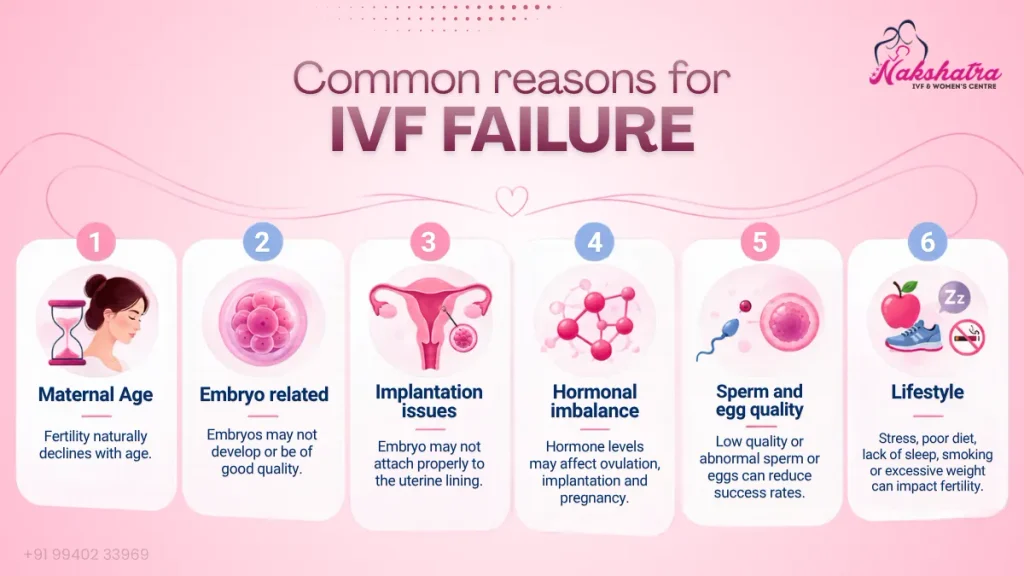
- Maternal age: Women’s age has a strong influence on the success rate of IVF. When women are 35 years or younger, the chances of success increase. Whereas for women aged 40 years and above, the chances of IVF failure are high.
- Embryo-related: The embryo quality plays a leading role in the cause of IVF failure. Any chromosomal abnormalities present in the embryo can result in failures. Visually, the embryo may appear normal in the lab, but when implanted, there is a possibility it may fail.
- Implantation issues: Uterine polyps, high progesterone levels, infection, or thin endometrial lining can cause implantation issues and result in failed IVF. Failed transfers, such as missed timing that does not align with the natural window of the woman, may also result in a failed IVF cycle.
- Hormonal imbalance: Disturbances in the hormonal profile can interfere with IVF results. The main hormones that seem to influence IVF results are progesterone, estrogen, thyroid hormones, and prolactin. Talking to a fertility specialist in Chennai can help evaluate and treat hormonal imbalances influencing fertility.
- Sperm and egg quality: Low sperm count, poor motility, high DNA fragmentation, or abnormal morphology may result in unhealthy embryos. When male infertility factors are present, doctors may suggest other techniques like ICSI. The quality of the egg is also equally important for a successful IVF cycle. Maternal age, PMOS, endometriosis, oxidative stress, and reduced egg count are some of the factors that influence egg quality.
- Lifestyle: Smoking, alcohol drinking, poor dietary habits, stress, improper sleep cycle, and body weight challenges are some of the lifestyle-related factors that play a role in the success of fertility treatments.
Why a Detailed Review Matters Before the Next IVF Attempt?
Immediately starting a new cycle without investigating the cause of IVF failure in the previous attempt is generally not recommended. IVF failure can occur for a variety of reasons, and it is important to evaluate and identify the root cause. A thorough evaluation can provide a clear understanding for the IVF specialists to develop solutions and make appropriate modifications to the treatment plan. This critical step after a failed IVF cycle can help optimise the chances of success in the next cycle.
Tests To Evaluate After An IVF Failure
In some scenarios, doing some advanced tests can help provide more information to guide your doctor with the next steps. Depending on the cause of IVF failure, some of the following tests may be suggested by your fertility expert.
- Uterine cavity assessment: A hysteroscopy, 3D ultrasound, or saline sonography are some of the tests that help assess the uterus. These tests help identify hidden polyps, scarring, inflammation, and changes in the shape of the uterus.
- Endometrium assessment: An endometrial biopsy is recommended for recurrent IVF failures to check for chronic inflammation like endometritis.
- Hormonal assessment: Metabolic health and hormonal balance also play a role in the success of IVF. Thyroid profile, glucose, insulin, and prolactin are the common hormones to be assessed after an IVF failure.
- Clotting and immune-related markers: Blood clotting tests and antiphospholipid antibody panels help evaluate coagulation disorders and autoimmune conditions.
- Genetic assessment: Embryo genetic testing (PGT-A) and karyotyping of both partners help check for chromosomal abnormalities such as changes in the number or structure.
- Male-factor assessment: A thorough semen analysis helps identify the sperm count, shape, and motility. Sperm DNA fragmentation helps evaluate the integrity of the sperm’s DNA and identify damage in the DNA that may be affecting embryo growth or pregnancy.
The Cause of IVF Tells the Next Step of Treatment
Once the cause for IVF failure has been identified, the next step of treatment should be focused on managing the root cause before starting the next cycle. The table below simplifies the possible approaches your doctor may recommend as a next step of treatment.
| Type of IVF failure | Treatment approach that may be recommended | |
| Uterine abnormalities | Septate uterus | Hysteroscopic septum resection |
| Submucosal fibroids | Hysteroscopic removal | |
| Endometrial polyps | Hysteroscopic polyp removal | |
| Hormonal abnormalities | Thyroid disorders | Hormone therapy |
| Diabetes | Regulating blood glucose with insulin or medications | |
| PMOS | Symptom management | |
| Blood clotting factors | Antiphospholipid syndrome (APS) | Anticoagulant |
| Chromosomal factors | Chromosomal abnormalities | PGT-A or PGT-M, modifying medications or dosages, donor gametes |
When Should You Start Your Next IVF Cycle?
Letting your body rest and recover before starting the next IVF cycle is advisable. It is generally recommended to wait until one menstrual cycle is completed before beginning the next IVF. However, it is best to allow your fertility specialist to make the decision. Your doctor may suggest waiting a little longer to ensure any underlying issues are fully resolved before your next treatment cycle.
Preparing Your Body and Mind for Your Next IVF Cycle
Apart from being medically fit to try IVF again after a failed attempt, it requires the couple to be physically and mentally ready. The signs of failed IVF can lead to anxiety and stress. Especially for couples going through 3 failed IVF cycles or RIF, it can cause an incredible emotional and physical strain. Before starting your next IVF cycle,
- Focus on recharging your physical health by following a healthy lifestyle. Starting with eating nutritious, balanced food, sleeping well, and staying active can be highly beneficial.
- Manage stress and emotional wellbeing by seeking professional help. Talking to a mental health counsellor offers a safe space to manage anxiety.
- Participate in support groups with couples who are going through a similar situation. This can be a gentle reminder that you are not alone.
- Be fully aware of your fertility situation and set the right expectations. This can help navigate this journey more smoothly.
- Have an open conversation with your fertility specialist. It can help in understanding your treatment response, the main cause of your previous failed IVF cycle, and being fully prepared for your next IVF attempt.
Preventing IVF Failure: Is it Possible?
The success of IVF treatment is not always guaranteed. Identifying any fertility issues present before starting IVF provides an opportunity to address them early and increase the chances of success. Treating uterine conditions, regulating hormonal disturbances and blood glucose levels, managing lifestyle factors, and using genetic testing to choose healthy embryos are some of the strategies to increase the chances of a successful IVF cycle.
Takeaway Message
A negative result after an IVF cycle does not mean that your chances for a successful pregnancy are over. Understanding the root cause, getting advanced tests done if required, and modifying the treatment protocol for your next cycle is the best way to move forward. Whether you have experienced one or three failed IVF cycles, it may greatly impact your physical and emotional health. Hence, seeking professional guidance and having open conversations with your IVF specialist can definitely be beneficial during this complex journey.
Medical Disclaimer
This article is for informational purposes only and does not substitute professional medical advice, diagnosis, or treatment. Always consult a qualified healthcare provider before making any health-related decisions.
Your IVF Journey is just a consultation away
Our experienced and highly trusted IVF specialists will provide expert guidance, compassionate care, and personalised treatment plans that will support your fertility journey.

Frequently Asked Questions
Most couples experience one or two failed IVF cycles. Repeated failures are generally due to embryonic, uterine, or immunological factors.
There is no maximum limit for IVF failures to occur. The chances of success seem to increase over multiple cycles.
The success rate for IVF has shown a drop after a maternal age of 35 years and reaches the lowest around 40 years and above.
Experiencing IVF failure can take a toll on your physical and emotional health. Hence, it is important to take rest and give adequate time for the body and mind to be prepared for the next cycle. Processing the situation, identifying the cause for failure, and modifying the treatment accordingly are practical ways to recover from a failed IVF cycle.
Yes, there is a chance of getting pregnant naturally after a cycle of IVF failure. During the process of IVF treatment, the cause of infertility (hormonal imbalance, stress, uterine problems) is being treated, which increases the chance for natural pregnancy to occur.
The signs of successful IVF are a positive beta-hCG blood test and rising hormone (progesterone and estrogen) levels. The beta-hCG test is usually scheduled 9 to 14 days after embryo transfer. Once the blood tests show positive results, an ultrasound is done around weeks 6 to 8 of pregnancy.