Women Fertility Women Health
Cycle-Smart Intimacy: Safe Days, Fertile Window, and Fertility Awareness Methods
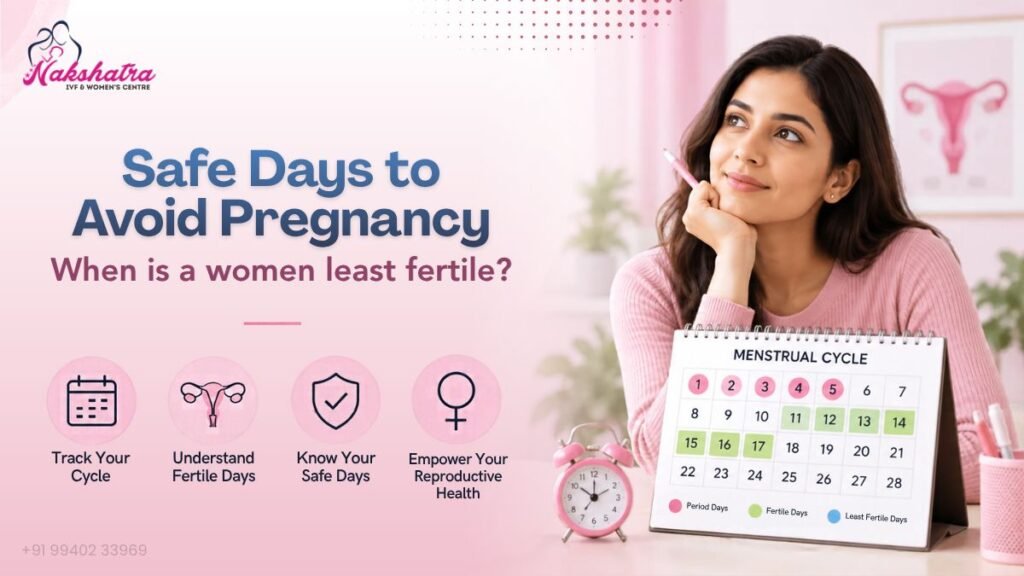
Knowing your fertile window opens your ability to predict safe days for intimacy with your partner. The ovulation phase is the most important days in the menstrual cycle that holds the highest chances of getting pregnant, and helps you make the right decision on family planning.
Key Takeaways
- To estimate the chances of pregnancy, it is essential to know and understand the timing of ovulation during the menstrual cycle.
- Pregnancy is most likely to can occur near the time of ovulation.
- The fertile window (the period most likely to get pregnant) can be tracked using different fertility awareness methods.
- After unprotected sex, the sperm could stay alive up to 5 days in the female reproductive system.
Menstrual Cycle: Breaking Down The Biology
On average, the menstrual cycle (மாதவிடாய்) may last around 28 days, though variations may occur for each individual. A healthy menstrual cycle is said to last between 21 and 35 days. It involves the harmony of different organs and hormones in the body to regulate the menstrual cycle.
The menstrual cycle is a result of hormonal communication between the brain and uterus. The cycle is coordinated orchestrated by a network of hormonal signals from the hypothalamus-pituitary-ovarian (HPO) axis. The gonadotropin-releasing hormone (GnRH) is released by the hypothalamus, which in turn stimulates the pituitary gland to produce the two primary gonadotropins- the follicle-stimulating hormone (FSH) and luteinising hormone (LH). These gonadotropins induce the ovaries to produce estrogen and progesterone. The entire cycle is regulated by a feedback mechanism between the different components. It is crucial for every woman to talk to Chennai’s female fertility specialist and understand your cycle before planning pregnancy.
Fact Drop:
Do you know how many menstrual cycles a woman has in her entire life?
In her entire lifetime, a woman may go through between 300 and 400 menstrual cycles. This may vary for each individual depending on age, genetics, BMI, lifestyle, and medical conditions.
What are the Four Phases of the Menstrual Cycle that Control Fertility?
The entire cycle is separated into four phases according to the levels of hormones: Menses, Follicular, Ovulation, and the Luteal Phase. Understanding these phases aids in predicting safe days for sexual intercourse.
Variations in the cycle occur for most women. Even when they have regular periods, factors such as stress, travel, and lifestyle changes can affect the cycle.
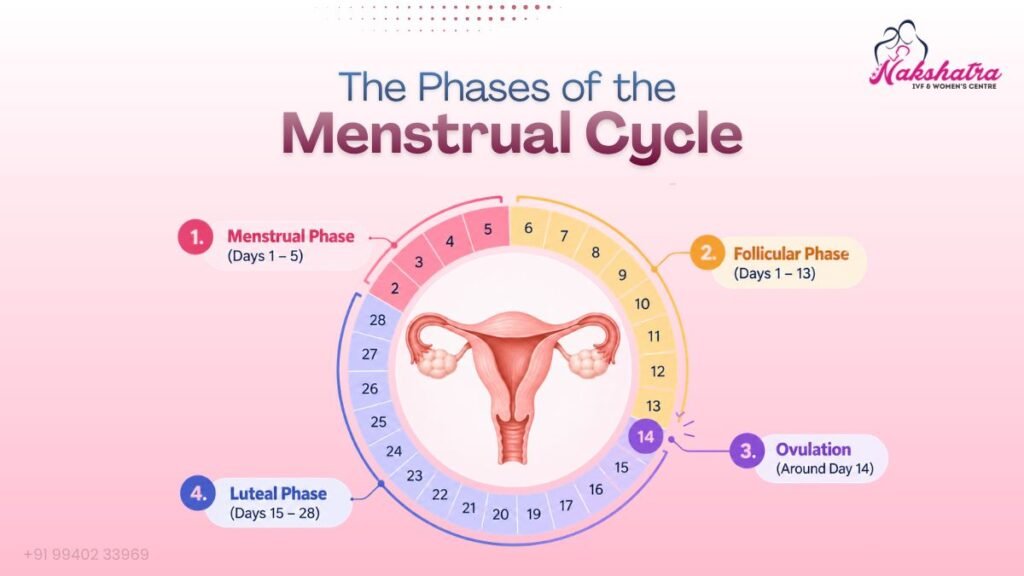
- The menses phase is the first day of the period. Bleeding may occur for three to five days and may vary for every woman.
- The onset of periods initiates the follicular phase and occurs simultaneously with the menses phase. This stage is marked by the spike in estrogen levels in order to grow and thicken the lining of the endometrium. While the follicle-stimulating hormone stimulates the follicles in the ovaries to develop into fully mature eggs, called the ovum. Mature eggs may develop between days 10 and 14.
- Roughly around day 14, the ovulation phase begins. This is marked by the spike of luteinising hormone (LH), which causes the ovary to release the mature egg. This is the most important phase that primarily increases the chance of pregnancy.
- The last phase is the luteal phase that lasts from days 15 to 28. The released mature egg travels from the fallopian tube to the uterus, where it can be fertilized by sperm. When fertilisation does not occur, menstruation occurs with the shedding of the uterus lining along with the egg.
What Does “Safe Days” Mean?
Safe days, or the infertile window, are the days when women have less chance of becoming pregnant. This may be a safe time to have unprotected sex and avoid pregnancy. Keep in mind that there is always a slim chance that this may not work, and using a contraceptive is highly recommended if pregnancy needs to be avoided. The safe days for sex are influenced by the lifespan of the sperm and the egg.
Can You Have Unprotected Sex While on Your Period?
The time when there is no egg present to be fertilised is considered the safe days to avoid pregnancy.
There are low chances of getting pregnant right before your period or the menses phase (approximately 7 days before periods if the cycle is regular).
The length of the periods also influences the chances of pregnancy. For women having a regular cycle (average of 28 days) with shorter period days, the chances of getting pregnant during and right after periods are high after vaginal penis-in-vagina sex. This is because they may be ovulating early and may have had sex at the end of their periods. Hence, using contraceptives (கருத்தடை) or any birth control method is the best way to worry-free intimacy and avoid pregnancy.
Science Says
The chances of pregnancy start increasing spiking from day 8 of periods and reach a maximum on day 13, and decrease to zero by day 30 or the end of a cycle.
Menstrual Phases and Fertility
The table below summarizes the safe and unsafe days for a menstrual cycle lasting 28 days.
| Stage of Menstrual Cycle | Days | Fertility |
|---|---|---|
| Periods or Menstruation | 1–7 | Safe (least fertile) |
| Post-menstruation or Follicular Phase | 8–9 | Unsafe (might get pregnant) |
| Ovulation | 10–14 | Unsafe (most fertile) |
| Post-ovulation or Luteal Phase | 15–16 | Unsafe (might get pregnant) |
| Luteal Phase | 17–28 | Safe (unlikely to get pregnant) |
Avoid Sex During Fertile Days to Avoid Pregnancy
Knowing the fertile window during your menstrual cycle is very important for family planning. The 4 to 5 days closer to ovulation, the day of ovulation, and a day after ovulation are the days with high chances of getting pregnant, and hence called the fertile window of the menstrual cycle. Having unprotected vaginal sex during these days increases the chances of fertilisation of the egg by the sperm and thereby, a positive pregnancy result.
Science Says
The American College of Obstetricians and Gynecologists (ACOG) states that women with menstrual cycles lasting between 26 days and 32 days have their fertile window between days 8 and 19 of their cycle.
What is the Life Span of Sperm in the Uterus?
Despite tracking their period cycles closely and timing sexual intercourse during the presumed “safe” days, many women still experience unintended or surprise pregnancies. Here’s what they forget- the sperm that has stayed alive for days in their uterus.
In general, after ejaculation, sperm can survive for about five days, and there is a chance one can get pregnant.
Tracking the Fertile Window Using The Fertility Awareness Methods
There are different fertility awareness methods that can be used to predict the safe days to have sex with your partner and avoid pregnancy. These methods are not fail-proof and may not be the most effective way to have unprotected sex and prevent pregnancy. Some of them are explained below.
- Mark your calendar: This method can be helpful when you have a regular period cycle. The first day of your period marks day 1 of the menstrual cycle. The number of days between the first day of your period gives you an idea of your typical cycle length. When you know your cycle length and number of bleeding days, you can predict your ovulation timing or the fertile window and the safe days for sex.
- Checking on cervical mucus discharge: The amount, colour, odour, and consistency of vaginal discharges like the cervical mucus can help predict your safe and fertile days. For most women, the days right before and during ovulation, the mucus becomes increasingly noticeable, and appears as a thin, stretchy, or slippery discharge (almost like the consistency of raw egg whites). When ovulation ends, it becomes less noticeable and may feel sticky and thicker in appearance. It is best to avoid having unprotected sex when discharge occurs during the ovulation period or fertile window.
- Monitoring basal body temperature: The temperature of the body when at complete rest is referred to as the basal body temperature. A rise in about 0.3°C or 0.5°F can be observed during ovulation and persists at a higher level throughout the remainder of your menstrual cycle. To practice this method, start recording your temperature every day immediately after waking up and before engaging in any activities.
- Using an Ovulation Prediction Kit (OPK): This kit, when used correctly, can confirm the days you are about to ovulate. It is similar to the home pregnancy test. The ovulation recognition kit recognises the works by spotting a spike in the luteinizing hormone (LH) levels in urine, which usually happens 24 to 48 hours before ovulation, thereby predicting the fertile window. It is required to do the test for several days, at least 3 to 5 days before you think you may ovulate, to note the surge in LH levels.
Do Fertility Awareness Methods Prevent Pregnancy?
Fertility awareness methods require close monitoring and tracking of your cycle. These methods can be 91% to 99% effective in preventing pregnancy after unprotected sex when followed correctly. However, there is always a chance for women relying on these methods to become pregnant. Taking human errors into account, about 24 out of 100 women who practice these natural family planning methods become pregnant.
Bottom Line
Fertility awareness methods, or natural family planning methods, help you to know and understand your menstrual cycle better and plan your pregnancy. Having unprotected sex during the safe or infertile days may avoid pregnancy. But not to forget that the life span of sperm also has a role to play. Factors like lifestyle, stress, and travel can significantly impact the menstrual cycle; potential shifts in the timing of ovulation can be expected.
Hence, based on your fertility goals, it is highly recommended to consult a fertility specialist or a medical professional about a reliable birth control method. Visit Nakshatra IVF & Women’s Centre to consult a fertility specialist about effective fertility awareness methods that may work for you.
Medical Disclaimer
This article is for informational purposes only and does not substitute professional medical advice, diagnosis, or treatment. Always consult a qualified healthcare provider before making any health-related decisions.
Your IVF Journey is just a consultation away
Our experienced and highly trusted IVF specialists will provide expert guidance, compassionate care, and personalised treatment plans that will support your fertility journey.