
Men Fertility
7 Effective Ways to Prevent Sperm Leakage After Sex
Overview
Worrying about sperm leakage after sex? Let’s simplify it. Sperm leakage after sex (உடலுறவுக்குப்பின் விந்து வெளியேருவது) is universal and not a serious concern to be overthought. Here is a comforting truth for our dear couples- the sperm leakage does not mean you have lost all the sperm or that your chance for pregnancy is affected.
Sperm coming out or leaking after sexual intercourse does not directly affect one’s chance for pregnancy. There are physiological factors that may be causing it, such as mucous thickness, vaginal structure, and volume of the ejaculate. Hence, sperm leakage is a completely natural phenomenon, and this blog will guide you with natural and practical methods to reduce sperm leakage.
What is Sperm Leakage?
Sperm leakage is the sperm coming out through the vagina after sexual intercourse. This is completely normal and may happen to anyone. The fluid that’s coming out is the excess seminal fluid. Many couples fear that sperm leakage could affect pregnancy, but this is a common misconception. The healthiest and most active sperm begin swimming towards the egg immediately after ejaculation, well before any leakage happens.
Hence, it is important to treat your anxiety with the right information. So, dear couples, next time you notice sperm leakage after sex, relax knowing that it does not affect your chance for conception.
💡 Fertility Fact:
Does sperm leakage mean there are only a few sperm in the vagina?
No. The semen that leaks out after sex is usually a very small amount and contains only about 5–10% of the total sperm. It is a completely natural phenomenon and is very common.
What are the Causes of Sperm Leakage after Sexual Intercourse?
Although sperm leakage or sperm coming out after intercourse is not a problem to be concerned about, many couples get anxious about it. When you’re planning a pregnancy, it’s important to understand what truly matters for conception. Being aware of the common causes of sperm leakage can give more clarity on its effect on fertility and pregnancy chances. The common reasons for sperm leakage are,
Amount of fluid (or) Ejaculate volume:
When a large amount of semen enters the vagina, there is a chance for leakage to occur. This is only the excess semen fluid that is coming out.
💡 Quick Fact:
A healthy male ejaculates about 1.5 to 5 mL of semen, and there are about 20 to 150 million sperm per mL of semen. Therefore, the sperm coming out is only a small amount, while thousands of them are already inside the cervix. lp should be received immediately.
Structure of the vagina:
The vaginal anatomy itself plays a crucial role and influences how and why sperm leakage occurs. The vagina has a narrow space and may not be able to hold all the fluid.
Gravity:
The semen in the vagina is usually deposited close to the cervix. Standing up or moving may cause the extra semen fluid to flow out.
Role of cervical mucus:
Cervical mucus is a fluid produced by the cervix that can help with the movement of sperm towards the egg. During the time of ovulation, the cervical mucus is thin and elastic, favouring the movement of sperm. Whereas when the cervical mucus is thick, the sperm may find it difficult to move, resulting in the sperm coming out.
💡 Fertility Fact:
Does sperm leakage signal infertility in couples?
No. Leakage of the semen after sexual intercourse does not mean infertility in either partner. The motile sperm would have already started moving towards the egg within minutes of ejaculation. The sperm coming out after sex does not affect fertility in any way.
Does Sperm Leakage Affect Your Chance of Pregnancy?
Yes, absolutely. You can still get pregnant even if there was sperm leakage.
The American Society for Reproductive Medicine (ASRM) states that active and healthy sperm travel at a fast pace towards the fallopian tube within minutes after ejaculation. Moreover, a motile sperm can stay alive for up to 3 to 5 days inside the female reproductive tract.
Given the millions of sperm in semen, only a few hundred may be lost during leakage, while the healthiest & motile sperm have already moved toward the egg. The sperm that leak out are those that would not have reached the egg anyway. Therefore, sperm leakage is insignificant and does not affect the possibility of conception.
To assess pregnancy outcomes, a few other essential factors should be looked at. Such as,
- Reproductive health of the couple
- Uterine factors
- Sperm health
- Egg health
- Ovulation timing
- Age
7 Practical Methods to Reduce Sperm Leakage After Sex
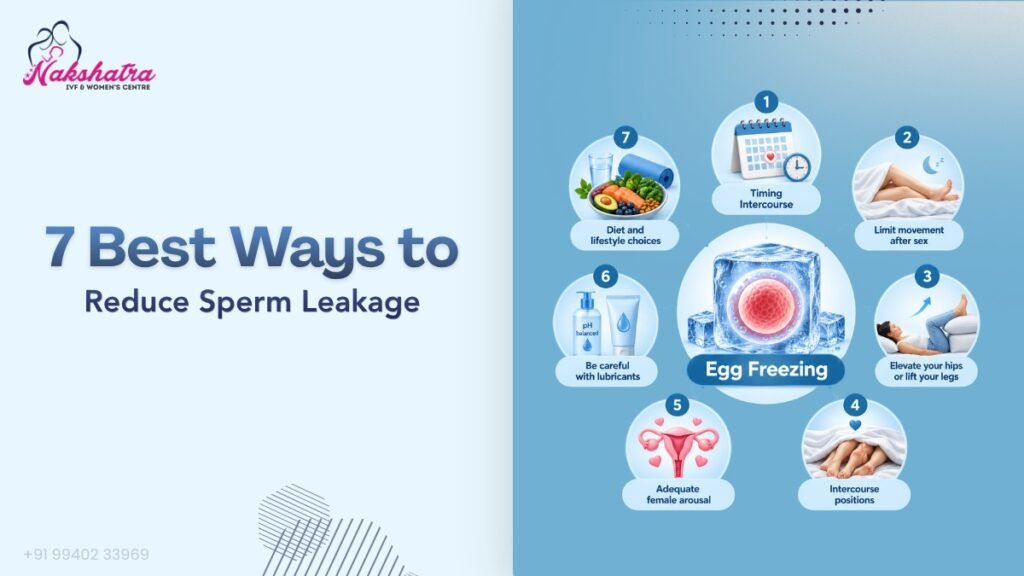
There are no scientifically proven techniques to reduce or prevent sperm leakage after sex. As already discussed, the small amount of sperm leakage that occurs does not have an impact on pregnancy outcomes.
But to improve the chances of successful fertilisation, there are seven helpful suggestions to follow. We will also help you separate myths from facts along the way.
Timing intercourse:
Optimizing timing for sexual intercourse can make a key impact. Experts from ASRM and ACOG note that having sex around the ovulation phase is best, as the woman is most fertile at this time. Ovulation typically occurs 14 days before the period starts.
Several studies have found that conception chances increase when intercourse is timed. The fertile window lasts for about 6 days, 5 days before ovulation and the day of ovulation. The egg survives in the female reproductive tract only for about 12 to 24 hours after being released by the ovary. Whereas the sperm can stay alive for about 3 to 5 days inside the female’s uterus. Hence, timing sexual contact around the days before and during ovulation ensures there is active sperm available to fertilise the egg when it is released.
Ovulation is also the best time to create a favourable environment for sperm. The cervical mucus produced around this time is clear, wet, and lubricative, helping sperm move upward towards the egg more easily.
A woman’s fertile window can be predicted using different methods like urinary hormone measurement, tracking basal body temperature, monitoring cervical mucus, cycle tracking apps, and ultrasonography.
Limit movement after sex:
Some ART studies suggest that staying still for 10–15 minutes may help, but evidence shows mixed results. In contrast, for natural conception, lying still after intercourse has not been proven to offer any benefit. However, there are also other studies that showed positive outcomes.
A study with almost 400 couples undergoing IUI found that the pregnancy rate was higher for those who lay still for 15 minutes after insemination. Another study found improvements with 10 minutes of bed rest after the procedure.
In a 2017 study, about 500 women undergoing IUI (intrauterine insemination) were assessed based on this idea. The study showed that about 40% of women who moved immediately after IUI achieved a positive pregnancy result, compared to 32% of those who remained still.
Changing positions, getting up, or walking has not been scientifically shown to cause the sperm to come out. Remember, the sperm start swimming towards the egg within seconds of ejaculation and may reach the fallopian tube within 15 minutes. Therefore, limiting movement and lying still is a personal choice and not a proven technique.
However, for women undergoing ART procedures like IUI treatment, lying still for some time after the procedure may be recommended by fertility experts.
Elevate your hips or lift your legs:
While lying still immediately after intercourse, prepping the hips by placing a pillow under your hips may help the semen move toward the uterus and avoid leakage. This method can slow down the semen backflow that may occur.
After sex, lying on your back and gently raising your legs may also assist with the sperm’s movement and slow down backflow. Some people may prefer resting the legs against a wall. However, no research shows that it can increase your chance of pregnancy. It is best to practice what feels comfortable for you, as there are no proven methods that impact pregnancy.
Intercourse positions:
When trying to get pregnant, most couples would probably want to try everything to make it happen. Another common doubt is if sexual positions matter. The best thing to do is to make sure the sperm is deposited close to the cervix. Practicing positions that help with deep penetration and controlling sperm leakage by depositing sperm close to the cervix may be helpful. The commonly suggested position is the missionary position. However, there is insufficient evidence on optimal sexual positions to control sperm leakage. Speaking with Chennai’s best fertility experts can guide you with the right information about sperm leakage and factors that matter for conception.
Adequate female arousal:
Optimal and healthy arousal can make intercourse comfortable for both partners. Ensuring adequate orgasm may cause uterine contractions that may help with sperm movement. However, be clear that female orgasm does not relate to pregnancy outcomes. Engaging in enough stimulation with foreplay also supports natural lubrication and may be a helpful practice.
Be careful with lubricants:
The use of lubricants may be required for some couples, especially when frequent intercourse is practiced. Research has shown that some commercially available lubricants reduce sperm motility (விந்துறும் சக்தி) in vitro. However, there is a lack of evidence showing reduced natural pregnancy chances with the use of lubricants.
For couples trying to conceive, choosing sperm-friendly lubricants can be a better and safer option.
Diet & lifestyle choices:
Adopting a healthy lifestyle can improve both female and male reproductive health. Multiple studies have found that following a fertility- friendly diet that is rich in vegetables, plant protein sources, low-glycemic carbohydrates, MUFA, and low-fat dairy products helps lower the risk of infertility. Regular exercise, maintaining adequate hydration daily, and limiting the use of alcohol and smoking are advisable to promote reproductive health among both genders.
When Should You Consult a Fertility Specialist?
Now that we know that sperm leakage is a natural phenomenon, it’s important to know that certain signs should not be ignored. While leakage itself does not affect fertility, consulting Chennai’s top fertility specialists can help improve your chances of pregnancy when other concerns are present.
One key sign is the inability to conceive after 12 months of regular, unprotected sex-even if sperm leakage occurs frequently.
Additionally, frequent or excessive sperm leakage along with symptoms such as pain during ejaculation or urination, blood in the semen, changes in sexual function, or noticeable ejaculatory changes needs medical assessment. These are warning signs that require timely consultation with a fertility doctor.
Less Worry. More Clarity.
Understanding that sperm leakage is a natural process and not a sign of infertility or reduced chances of pregnancy is important for couples. Getting pregnant should be carefully planned with full awareness of reproductive health. So even when you notice sperm leakage next time, be assured that the most active, healthy sperm is already on its way towards fertilising the egg. Gaining more clarity on better practices for improving the chances of pregnancy is more crucial than worrying about sperm leakage.
Your IVF Journey is just a consultation away
Our experienced and highly trusted IVF specialists will provide expert guidance, compassionate care, and personalised treatment plans that will support your fertility journey.