
Women Fertility Women Health
AMH Test in Chennai: When to Test, What it Tells, & Age-Wise Chart

Overview
Did you know that two women of the same age, who are healthy and living similar lifestyles, can have very different reproductive timelines? The woman’s ovaries (கருப்பைகள்) are like a savings account with a fixed balance and have no access to new deposits. The number of eggs in her ovaries is fixed from birth and over time (after puberty) withdrawals are made. As a result, the number of eggs gradually starts reducing throughout her reproductive phase. A non-invasive way to estimate the ovarian reserve is the Anti-Mullerian Hormone (AMH).
Keynotes:
- Anti-Mullerian Hormone (AMH) test measures the level of AMH hormone in the blood.
- The amount of AMH helps estimate the number of eggs in a woman’s ovaries (ovarian reserve).
- It is not a measure of fertility and does not interpret the possibility of natural conception.
- The AMH levels are interpreted based on age-specific reference ranges.
- The levels seem to drop with advancing age.
- The AMH test helps couples make informed choices about their reproductive health.
Anti-Mullerian Hormone Test: What is it?
Anti-Mullerian Hormone, or AMH, is a hormone naturally produced in the body by both men and women. It is produced by the testicles in men and in the ovaries in women. The AMH test is a common test that measures the amount of hormone present in the blood to get an estimate of the ovarian reserve. The AMH hormone levels by age naturally decline over time, and hence the reference values differ by age group.
The granulosa cells present in the growing follicles in the ovary produce the anti-mullerian hormone. The role of the hormone differs in males and females. This hormone helps form the sexual organs and genitals in the fetus. Male fetuses have a higher AMH level than female fetuses. In females, the hormone level rises after puberty as the ovaries start producing it.
Do you know how many eggs women are born with?
Women are born with a finite number of eggs, which is typically around 1 to 2 million. This is the total number of eggs they will have throughout their lifetime.
The Role of AMH Test in Fertility Treatment
The AMH level is used for different purposes in fertility medicine. It measures the quantity of eggs and not the quality. Hence, it does not predict the chances of pregnancy. If you are consulting a gynecologist in Chennai for fertility treatment or egg freezing, you are most likely to get an AMH test done.
This test helps your doctor assess the number of eggs remaining and identify the most suitable treatment options. When normal AMH levels are present, doctors may advise IUI (intrauterine insemination) as a first-line option before IVF. Based on the AMH levels, doctors may advise whether egg freezing could be a good option for future family planning.
For fertility treatments such as IVF (in vitro fertilization), it can provide an estimate of how many eggs can be retrieved and support informed decision-making. It is also used to understand your response to treatment. A higher AMH level indicates that you are likely to respond well to fertility medicines and so may require only small doses.
The anti-mullerian hormone levels are also helpful in diagnosing ovarian conditions and monitoring treatment progress. The test is used to diagnose PMOS (polyendocrine metabolic ovarian syndrome), formerly called as PCOS and certain types of ovarian cancer that affect fertility. The hormone levels can also tell how well the treatment is working for you.
As a woman ages and approaches menopause, the number of eggs shrinks. The AMH test is also used to identify premature (before 40 years) and early menopause (before 45 years). A study identified that each 0.10ng/mL reduction in AMH level was linked with a 14% higher risk of early menopause.
Common Tests to Predict Ovarian Reserve: AMH, FSH, & AFC
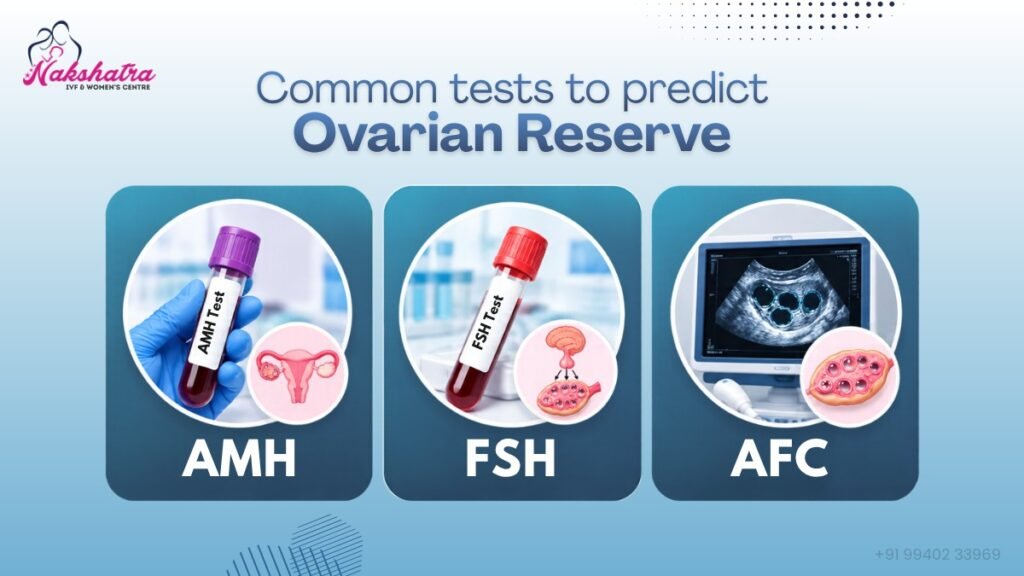
Predicting ovarian reserve is a useful method for fertility treatment planning and diagnosing reproductive conditions. The common tests that are referred to by doctors are AMH, FSH, and AFC tests.
- AMH: The anti-mullerian hormone (AMH) is the hormone produced by the follicles and is used to predict the number of eggs present. It is a simple blood test that can be done on any day of the menstrual cycle. In general, an AMH level below 0.6 ng/mL is associated with low ovarian reserve.
- FSH: Follicle-stimulating hormone (FSH) plays a crucial role in ovulation by stimulating the ovary to release an egg. The FSH test tells how well the ovaries are functioning, and its level is used to estimate the ovarian reserve. When the ovarian reserve is reduced, the brain releases higher levels of FSH to stimulate the ovaries. A low or normal FSH level indicates a good ovarian reserve. The hormone levels naturally tend to fluctuate during the cycle, and so, the FSH test is done on day 2 or 3 of the menstrual cycle. FSH levels more than 10 mIU/mL are an indicator of low egg count.
- AFC: Antral follicle count (AFC) test is used to measure the number of small, resting follicles (antral follicles) in the ovaries available in the current cycle. This is done during a transvaginal ultrasound, during which the physician can view and count the follicles. The AFC test is done on the early days (days 2 to 5) of the menstrual cycle. The number of antral follicles may vary every cycle and is dependent on age.
Studies show that the anti-mullerian hormone (AMH) level is a more reliable test to assess ovarian reserve. Combining the AMH test with the AFC test has been shown to improve evaluation accuracy. However, it is best to discuss with your fertility specialist to know the best test that suits your needs.
What Does Your AMH Test Result Mean?
Did you recently get the AMH test done and are not sure what the numbers mean? Remember that the AMH test only estimates the ovarian reserve and does not interpret the chances of conception. The hormone levels are influenced primarily by age, and therefore normal hormone levels can differ from one woman to another. The hormone levels begin to rise during puberty and reach a peak around 25 years. The reference values may also change between laboratories. The table below explains the AMH reference ranges in general.
| AMH levels | Interpretation |
| <0.4 ng/mL | Very low |
| 0.6 – 1 ng/mL | Low |
| 1 – 3.5 ng/mL | Normal |
| >3.5 ng/mL | High |
An AMH level between 1 and 3.5 ng/mL is linked with normal ovarian reserve. Levels below 1 ng/mL are associated with diminished ovarian reserve. AMH levels are categorized by age because age has a significant influence on hormone levels.
AMH Levels by Age Chart
AMH levels are greatly influenced by age. The hormone levels start showing a decline nearly 15 years before menopause, and about 5 years before menopause, they drop to a very low level. Different laboratories may interpret the results differently, but the AMH levels-by-age chart below will give you a good understanding. Let’s see what a good AMH level is for your age, as suggested in a study by the American Journal of Obstetrics & Gynecology (AJOG).
| Age Wise | Normal AMH Levels |
| 25 years | > 3 ng/mL |
| 30 years | > 2.5 ng/mL |
| 35 years | > 1.5 ng/mL |
| 40 years | > 1 ng/mL |
| 45 years | > 0.5 ng/mL |
If your results show you a number that falls outside the reference range, remember that it is not a final verdict on your fertility. Natural pregnancy is still entirely possible with abnormal AMH levels, as egg quality plays a much larger role in conception than egg quantity.
- Low AMH levels: If the levels fall below the reference range, it means there is a low ovarian reserve (egg count). However, it does not determine one’s fertility. The conversation around low ovarian reserve differs significantly between a 40-year-old and a 30-year-old. Low AMH levels may directly impact IVF, since it means there are few eggs for retrieval. Speaking with a fertility expert in Chennai can help you understand your AMH test results in the context of your age, health, and reproductive goals.
- Normal AMH levels: Values between the reference ranges indicate a good ovarian reserve. Women with normal AMH levels for age have a better chance of conception. However, taking a deeper look and looking at the age-dependent benchmarks is advisable.
- High AMH levels: Having levels above normal does not mean a good thing and may reflect an abnormally high ovarian reserve. A high AMH hormone level can also be a sign of PMOS (polyendocrine metabolic syndrome).
Should You Test Your AMH Levels?
Still wondering when to do the AMH test? The AMH levels by age chart illustrates how ovarian reserve naturally declines with age. For this reason, women who are 35 years or older may consider testing their AMH levels to better understand their reproductive health. There are more scenarios that suggest getting your AMH levels tested, like
- Difficulty in conceiving after a year of unprotected intercourse
- Family history of early menopause
- History of ovarian surgery
- Suspecting PMOS
- Having symptoms of menopause
- Considering advanced fertility treatments like IVF
- For a general understanding of your reserve and timeline
- Planning pregnancy later in life and considering egg freezing
Taking the AMH Test: What You Need to Know
The anti-mullerian hormone levels can be known with a simple blood test. The AMH test is a simple and quick procedure. There are no prior preparations required to get the test done.
During the test, a healthcare professional locates a vein in your arm and, using a thin needle, draws a small sample of blood. It usually takes only 5 to 10 minutes. The test can be done on any day of the menstrual cycle.
Is fasting required for testing AMH levels?
No, fasting or other special preparations are not required for an AMH test.
How does the Nakshatra Team Approach This?
From our vast experience in the fertility field, we understand that the AMH test is only one piece of the puzzle. While it estimates ovarian reserve, it does not reflect a woman’s fertility potential or chances of pregnancy. Our care team makes sure to educate couples about what their AMH numbers tell them, their fertility timeline, and the treatment options they can consider. We help them make informed decisions by promoting transparency and holistic care.
If you recently got your AMH levels tested and are concerned about what the numbers mean, it is highly advisable to talk to our fertility experts in Chennai. They can help you understand and plan your pregnancy journey that aligns with your ovarian reserve and reproductive goals.
Medical Disclaimer
This article is for informational purposes only and does not substitute professional medical advice, diagnosis, or treatment. Always consult a qualified healthcare provider before making any health-related decisions.
Your IVF Journey is just a consultation away
Our experienced and highly trusted IVF specialists will provide expert guidance, compassionate care, and personalised treatment plans that will support your fertility journey.

Frequently Asked Questions
In general, the normal AMH level is between 1 and 3.5 ng/mL. However, the AMH test is only a marker of ovarian reserve and does not directly predict pregnancy chances. Evaluating the results with the AMH level by age chart can be more ideal.
AMH levels above 1.5 ng/mL in 35 year old women generally suggest a typical ovarian reserve. However, the reference values may vary between laboratories.
In general, an AMH level of 1.4 ng/mL indicates low to moderate ovarian reserve. During IVF, women with this level will have a moderate response to fertility medicines.
AMH test can be taken on any day of the menstrual cycle and at any time of the day. Unlike other reproductive hormones, the anti-mullerian hormone levels remain stable throughout the cycle.
You should be concerned about your AMH levels when they are low or high for your age. However, AMH levels only indicate your ovarian reserve and do not tell about your fertility status.
A bad AMH level is when it is unusually low or high for your age. Since AMH levels naturally change with age, the reference range varies across different age groups.