Men Fertility
Can Men with Azoospermia Become Fathers? Advanced Treatments in Chennai
Overview
Male infertility is a common yet often overlooked cause of difficulty in conceiving. In many Tamil communities, fertility discussions are mostly focused on women, while men may feel reluctant to speak openly about it.
For many men, being diagnosed with azoospermia (no sperm in the ejaculate) can feel overwhelming and may lead them to believe that fatherhood is impossible.
Advanced fertility treatments like surgical sperm retrieval techniques and ICSI have opened new possibilities for several couples. Talking to a male fertility expert to diagnose the root cause and identify the available treatments for azoospermia can significantly increase pregnancy chances.
Quick facts
- About 1% of men have azoospermia.
- 10-15% of men with infertility are diagnosed with azoospermia.
- 30% of these men have obstructive azoospermia.
- >90% of successful sperm retrieval in obstructive azoospermia.
- 50% of infertility treatment includes male factors.
- >15 million sperm/mL is the minimum normal sperm count (WHO).
- >40% of motile sperm is considered normal.
What is Azoospermia
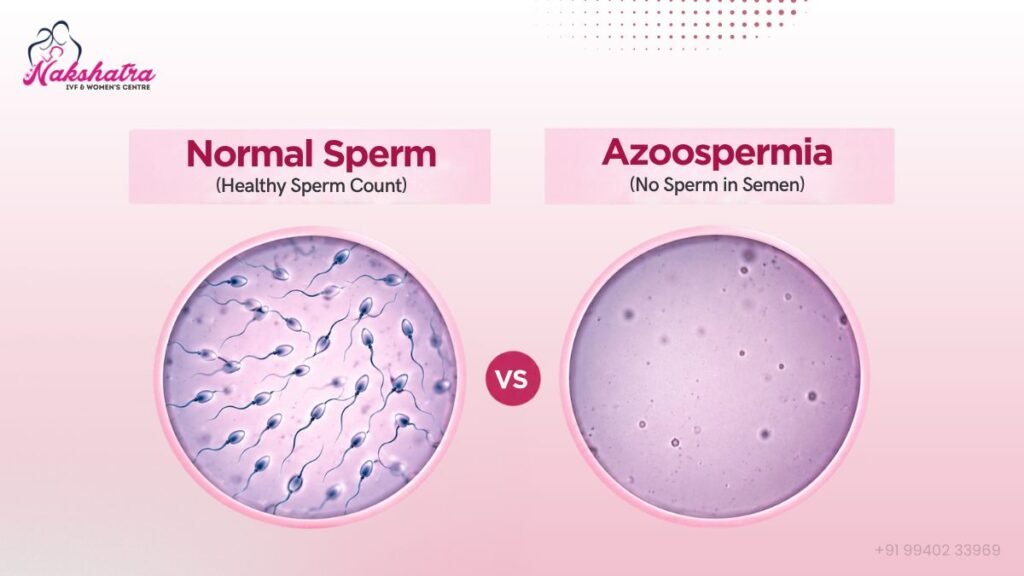
Azoospermia (விந்தணு இல்லாமை in Tamil) is the complete absence of sperm in the ejaculate. It may be caused by extremely low or no sperm production or obstruction in the passage from the testicles to the urethra. It is a common cause of infertility occurring in about 10% to 20% of men with abnormal semen analysis. Some men are born with azoospermia, while some may develop it later in life.
How common is azoospermia in India?
An interesting study that evaluated the male infertility burden in South Asia found that the prevalence of infertility in India was the highest (58.82%). The prevalence of azoospermia in India varies by geographical location. Another study among 447 Indian men showed that about 40% of them had azoospermia.
What are the Types of Azoospermia?
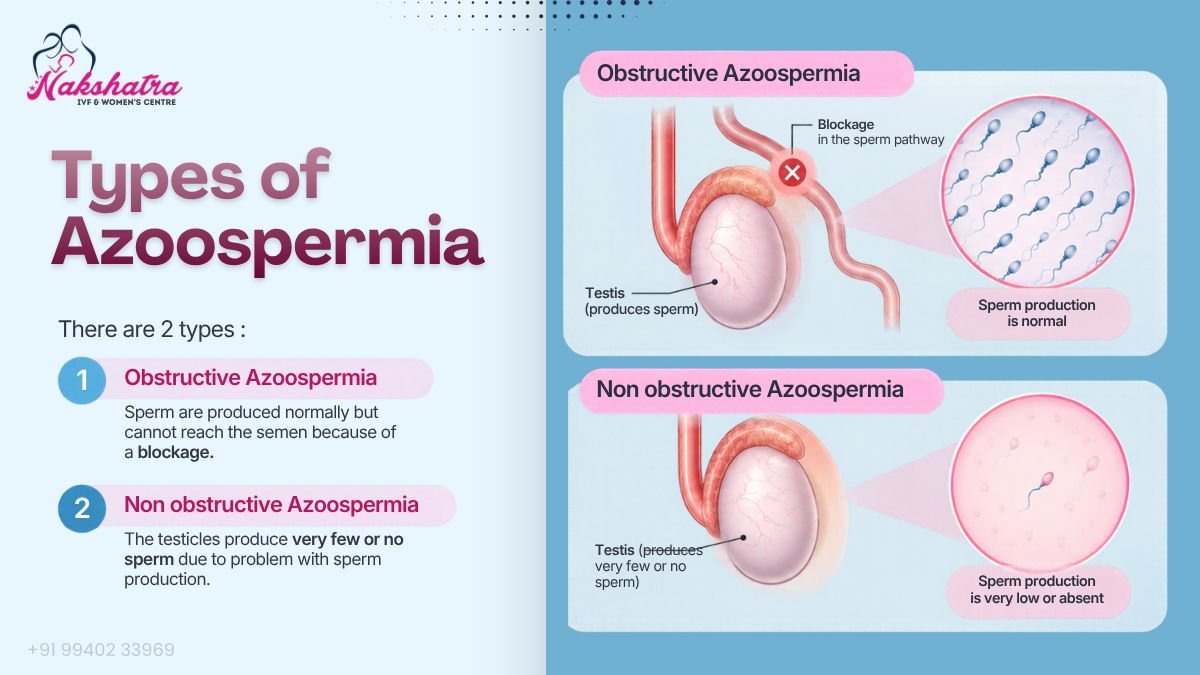
Identifying and understanding the type of azoospermia helps in planning an effective treatment plan. Consulting a male fertility specialist will help in determining why there is no sperm in the ejaculate. Azoospermia is classified into two types.
Obstructive azoospermia
Occurs when sperm production is normal but there are blocks in the reproductive tract for both the testicles (விதைப்பைகள்). The blockage prevents the sperm from reaching the ejaculate. The obstruction occurs mostly in the epididymis, vas deferens, and ejaculatory duct. The common causes are trauma or injury in the testicles, infections (e.g., epididymis), inflammation, cysts, genetic conditions like cystic fibrosis, or prior surgery.
Non-obstructive azoospermia:
Occurs when sperm production is less or not enough to be detected in the semen. This may be caused due to hormonal imbalances, genetic conditions (like Klinefelter syndrome, Kallmann syndrome), medications, radiation, chemotherapy, having undescended testicles, and unhealthy lifestyle.
Can Men with Azoospermia become Biological Fathers?
Being diagnosed with azoospermia can cause an emotional toll in men and couples. We have several men asking us, “Can I have a baby with azoospermia?” While in most cases pregnancy is possible, a fertility expert will do an in-depth evaluation before making any promises. The factors that influence the chances of fatherhood are
- Type of azoospermia
- General reproductive health
- Female partner’s fertility health
- Sperm retrieval success
- Treatment response
Does azoospermia affect pregnancy outcomes?
A study showed that azoospermia does not affect live birth rates compared with other causes of male infertility. However, paternal and maternal age were found to have a significant impact on live birth outcomes. Therefore, azoospermia itself does not appear to affect pregnancy outcomes when sperm retrieval is successful, and ICSI is performed.
Symptoms that Men with Azoospermia Should Watch for
Azoospermia is typically asymptomatic, and most men become aware of the condition only when they experience difficulty conceiving. The signs and symptoms that could be related to the underlying cause of azoospermia that men should not ignore are,
- Difficulty in getting pregnant after 12 months of unprotected pregnancy
- Less semen volume during an ejaculation or watery ejaculate
- Swelling in the testes
- Small or soft testicles
- Lumps or heavy scrotum
- Reduced sex drive
- Erectile dysfunction
Diagnostic Tests for Azoospermia
When addressing any sign or symptom that worries you, it is highly advisable to talk to Chennai’s leading male fertility experts to identify the cause. To diagnose azoospermia, a detailed health assessment and a few tests may be done by your fertility expert. Such as,
- Detailed history on medications, previous fertility treatments, infections, surgeries, family history of health conditions, and substance usage.
- Physical examination of the testes
- Semen analysis (sperm count, motility, and morphology).
- Hormone blood tests (like testosterone, LH, FSH)
- Ultrasound to evaluate structural blocks.
- Genetic testing
Treatment Options: From Diagnosis to Fatherhood
The treatment of azoospermia is entirely based on its type and the root cause. In case of mild and reversible scenarios, lifestyle changes can help improve sperm production.
- For obstructive azoospermia, a blockage in the reproductive tract is the main cause. In such cases, surgery may help restore the flow of sperm.
- For nonobstructive azoospermia, lifestyle modifications like a healthy diet, regular physical activity, adequate sleep, avoiding smoking, and maintaining ideal body weight are advisable. Medications may be recommended, particularly when hormonal imbalances contribute to the condition.
- When fertility treatments for pregnancy are considered, sperm retrieval techniques like PESA, TESA, or MicroTESE may be suggested.
Sperm Retrieval Procedures: PESA, TESA, MESA, Micro-TESE
The sperm retrieval process involves extracting the sperm directly from the testes with a needle. These techniques are followed when assisted reproductive technology (ART) like IVF and ICSI is considered. Simple sperm retrieval procedures are done on the same day of egg retrieval, whereas specialised procedures like MicroTESE are done the day before. The commonly used sperm retrieval techniques are discussed below.
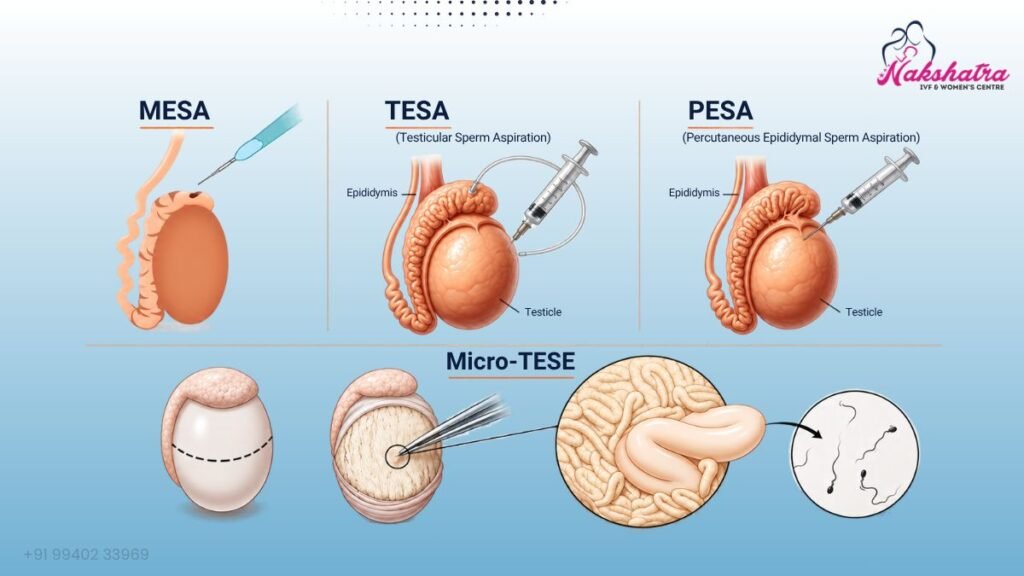
- TESA (Testicular Sperm Aspiration): This is performed for men with obstructive azoospermia, where a needle is inserted into the testicle, and the sperm is aspirated.
- PESA (Percutaneous Epididymal Sperm Aspiration): When a previous vasectomy or an infection causes obstructive azoospermia, PESA is recommended. A needle is inserted into the epididymis to withdraw the fluid.
- TESE (Testicular Sperm Extraction): In this procedure, a small incision is made in the testis to take a tissue biopsy and examine the presence of sperm.
- MESA (Microepididymal Sperm Aspiration): This procedure is performed for men with obstructions in the vas deferens or epididymis. It is an open microsurgical procedure in which sperm are collected from the epididymal tubules, yielding a large number of sperm.
- MicroTESE (Microsurgical Testicular Sperm Extraction): This is performed for men having issues with sperm production and is usually done the day before egg retrieval. Many patients prefer cryopreservation of the sperm obtained through this procedure for future IVF or ICSI treatment. MicroTESE is a significant method to improve sperm retrieval success rates.
Sperm retrieval procedures must be performed by trained fertility surgeons to prevent complications like bleeding or infection.
Pregnancy with Surgically Retrieved Sperm: Role of ICSI
Intracytoplasmic Sperm Injection (ICSI) is a specialised form of IVF in which a single sperm is injected directly into a mature egg. For men with azoospermia, ICSI may help achieve biological fatherhood when sperm are successfully retrieved through surgical procedures.
Since surgically retrieved sperm may be insufficient for IUI or conventional IVF, ICSI can be a suitable treatment option. Fertilisation rates may range from 45% to 75%, depending on individual clinical factors. At Nakshatra Fertility Hospital, our specialists offer personalised ICSI treatment in Chennai to help couples with male-factor infertility explore their path to parenthood.
What is the Success Rate of ICSI for Azoospermia?
ICSI is believed to be a promising treatment for couples with severe male infertility factors. Hence, in azoospermia, when surgically retrieved sperm are used for ICSI, the pregnancy rates range from 26% to 57% when viable sperm are found. Another study in 2024 found no difference in success rates when using fresh or frozen-thawed sperm. The success rates depend on several factors, such as:
- The woman’s age
- Sperm quality
- Expertise of the fertility lab
- Type of azoospermia
- General reproductive health
Consulting a Best Male Fertility Expert
In order to achieve successful treatment outcomes, seeking the guidance of a well-equipped and experienced fertility expert is crucial. A fertility specialist can help identify the root cause and provide the appropriate fertility treatment.
Talking to Chennai’s experts in fertility care can help the couple’s fertility journey with personalised treatment plans, advanced sperm retrieval procedures, advanced fertility treatments like ICSI, cutting-edge laboratory support, genetic counseling, and ongoing patient care.
Medical Disclaimer
This article is for informational purposes only and does not substitute professional medical advice, diagnosis, or treatment. Always consult a qualified healthcare provider before making any health-related decisions.
Your IVF Journey is just a consultation away
Our experienced and highly trusted IVF specialists will provide expert guidance, compassionate care, and personalised treatment plans that will support your fertility journey.

Frequently Asked Questions
Yes, men with azoospermia or zero sperm count can still have a biological child. Advanced fertility treatments like sperm retrieval techniques and IVF with ICSI help achieve a successful pregnancy.
No, but it depends entirely on the root cause. Treatable and reversible causes like hormonal changes or obstruction in the reproductive tract are usually temporary. Severe damage to the testicles due to trauma, injury, or genetic conditions is difficult to treat.
Obstructive azoospermia is when there is a block that prevents the sperm from reaching the semen. Non-obstructive azoospermia occurs due to lifestyle, medications, genetic factors, hormonal disturbances, or testicular issues.
While both are sperm retrieval techniques, they differ in technique and invasiveness. In MicroTESE, a microscope is used to target sperm-producing tissue. Whereas in TESA, a needle is inserted into the testicle and the tissue or fluid is aspirated. TESA is less invasive comparatively.
IVF with ICSI using surgically retrieved sperm is known to have a significant improvement in fertilization and pregnancy outcomes.
Treatment and recovery depend on the type of azoospermia. Reversible and treatable causes like lifestyle, hormonal imbalances, or blockages can be treated.
Fertility treatments, especially those requiring cutting-edge technologies, are expensive. The cost for initial diagnosis and treatment for azoospermia may range from Rs. 1,50,000 to 3,50,000. The treatment cost may depend on the severity of the condition, treatment method used, fertility center, and the geographical location.