IUI vs IVF vs ICSI: A Comparison Guide
Overview
Often, we are asked by couples if IUI, IVF, or ICSI is best. Having a clear understanding of these fertility treatments is important when planning your journey toward pregnancy. Although all three are commonly used fertility treatments, they differ significantly in their procedures, indications, and success rates.
Being aware of the difference between IUI, IVF, and ICSI can help couples understand the treatment suggested for them, be prepared for it, and make informed decisions. Every couple dreaming of parenthood naturally wants the very best option, so it is common to wonder which of these treatments is the most effective.
Well, the phrase “one size does not fit all” goes well here too. Every fertility journey is unique. There’s no one best treatment, but an experienced fertility specialist can help you get the fertility treatment that best suits your circumstances.
Defining Infertility
According to the World Health Organization (WHO), infertility is defined as a disease of the male or female reproductive system marked by failure to achieve a pregnancy after 12 months or more of regular unprotected sexual intercourse.
Infertility in men and women can be due to different reasons.
- Infertility in women could be due to blocked fallopian tubes, ovulatory dysfunction, uterine problems, age, lifestyle, and environmental factors.
- Infertility in men could be due to erectile dysfunction, poor sperm health, ejaculatory issues, blockages, hormonal imbalance, and lifestyle factors.
- There are also individuals with unexplained infertility, where the cause is not clear.
A 2026 review study found a combined prevalence of infertility to be 8% among Indian women aged 15 to 49 years. According to the NFHS-6 (2023-2024), the total fertility rate in Tamil Nadu dropped from 1.8 (NFHS-5) to 1.7. In many cultures, including our Tamil culture, infertility (குழந்தையின்மை in Tamil) is often linked with social value and family identity. Many couples in Tamil Nadu facing infertility undergo several challenges, and women are more likely to face the blame and shame associated with this stigma. Thanks to advanced reproductive treatments such as IUI, IVF, and ICSI, several couples have been able to fulfill their dreams of parenthood.
Understanding IUI
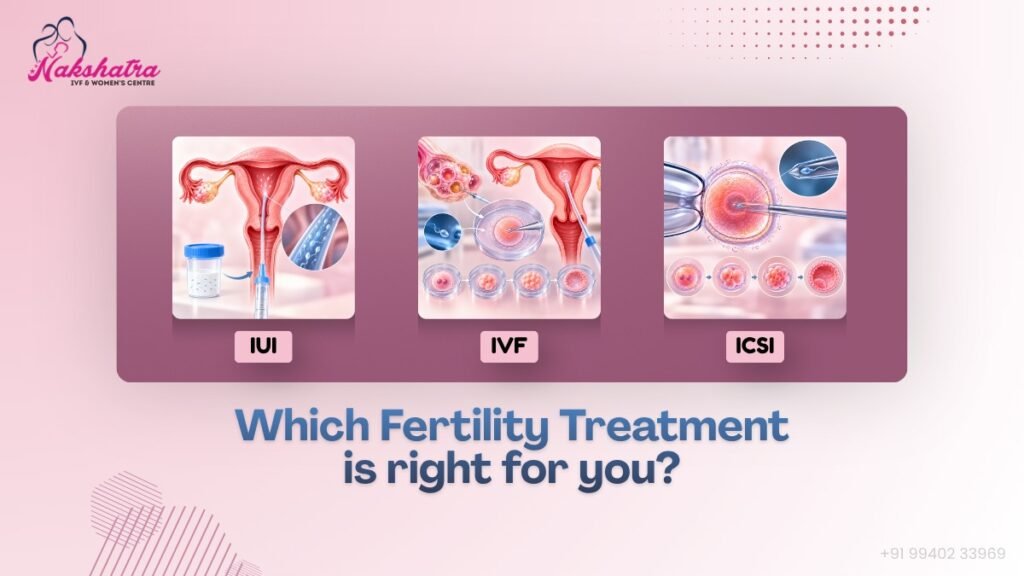
The full form of IUI stands for Intrauterine insemination. IUI is a first-line, non-invasive reproductive treatment. It is a form of artificial insemination (செயற்கை விந்தூட்டல்). This method of treatment involves placing the sperm (washed and concentrated) directly inside the uterus. This procedure is done during the woman’s ovulation phase.
The IUI treatment reduces the time and distance that the sperm has to travel to fertilize the egg. It helps sperm reach the egg faster and more easily. Most fertility experts suggest IUI as the initial treatment for couples experiencing infertility.
Scenarios where IUI is used
IUI is recommended when conditions such as cervical mucus problems, reduced sperm count, poor sperm motility, erectile dysfunction, ejaculatory difficulties, semen allergy, or unexplained infertility are present. IUI is also used when donor sperm is used.
Success rate
IUI success rate depends on age, health condition, and use of fertility medicine. But it tends to be higher among people under 38 years old. On average, IUI success rates range between 5% and 20% per cycle.
Advantages
It is a non-invasive procedure that mimics natural conception. It can be performed without the use of medications as well.
Now that you know what IUI is, let’s dive into the next treatment and understand the differences between IUI and IVF.
Snippet
Is IUI a part of the IVF process?
No. IUI and IVF differ in the procedure, cost, and success rate. The difference between IUI and IVF is that IUI places sperm directly into the uterus, while IVF includes fertilization outside the body.
Understanding IVF
IVF is a groundbreaking assisted reproductive technology (ART) that was developed in the late 20th century. Presently, about 2% to 5% of all births worldwide are achieved through IVF treatment.
The full form of IVF is in vitro fertilization, and as the name implies, IVF involves fertilizing the eggs and sperm outside the body (in vitro) in a controlled laboratory environment. The IVF process involves several steps, including: stimulating the ovaries to produce multiple mature eggs; retrieving the eggs; collecting sperm and treating it; combining the sperm and eggs for fertilization; monitoring embryo development; and transferring the embryo into the uterus.
Scenarios where IVF is used
When the sperm is unable to fertilize the egg inside the woman’s body, IVF is the commonly suggested treatment. Blockages or damage in the fallopian tubes, endometriosis, ovulation disorders like PCOS, fibroids, history of birth control surgery, risk of genetic disorders, unhealthy sperm, and unexplained infertility are common situations in which IVF is suggested.
Advantages
The use of advanced embryo selection methods in IVF enhances the possibility of pregnancy. It may also be used to prevent certain inherited genetic conditions from being passed on to the fetus. IVF also enables embryo cryopreservation when more than one good-quality embryo is obtained from the cycle.
Success rate
The average success rate of IVF for women below 35 years ranges from 40% to 50%. However, the IVF success rate is influenced by the women’s age, embryo quality, and expertise of the treatment team.
Understanding ICSI
Intracytoplasmic sperm injection (ICSI) is a specialised form of IVF treatment. Understanding the key difference between IVF and ICSI is crucial before starting your fertility treatment. ICSI differs from IVF by one crucial additional step. From the collected sperm, a single healthy, motile sperm is selected and directly injected into the cytoplasm of the egg.
In conventional IVF, several sperm are placed with a mature egg for fertilization. Therefore, the main difference between IVF and ICSI is how the sperm fertilizes the egg in the lab.
Scenarios where ICSI is used
Fertility experts generally recommend ICSI when male factor infertility such as low sperm count, reduced motility, or abnormal morphology, is present. When previous IVF failures have occurred, couples may be suggested to consider ICSI treatment.
Advantages
With ICSI, the healthiest and highest-quality sperm is selected and directly injected into the egg. This helps in increasing the chance of fertilization.
Success rate
The success rate of ICSI depends on the woman’s age, the couple’s overall health, and lifestyle. Generally, a 70% to 80% success rate is achieved with ICSI. However, ICSI does not increase the live birth or pregnancy rates.
IUI vs IVF vs ICSI: Differences in Treatment Cost
The cost differences between IUI, IVF, and ICSI vary depending on the specific treatment requirements, medication costs, and the geographic location of the fertility clinic. IUI is generally less expensive and affordable compared to the other two treatments. The cost is also one reason that makes IUI an accessible first-line treatment for many couples. However, the success rates of IUI per cycle are comparatively lower than IVF and ICSI. The advanced technology and comprehensive medical support make IVF and ICSI more expensive than IUI treatment.
IUI vs IVF vs ICSI: What’s the Difference?
Having a clear perspective of the available treatment options and the differences between them is essential for every couple before starting their fertility journey. Now that we’ve explored each treatment in detail, the table below provides a side-by-side comparison to help you gain a clearer understanding of how IUI, IVF, and ICSI differ.
| Category | IUI | IVF | ICSI |
|---|---|---|---|
| Full form |
Intrauterine insemination | In vitro fertilization |
Intracytoplasmic sperm injection |
| Fertilization |
Occurs naturally inside the body |
Occurs outside the body (in a lab) |
Occurs outside the body (in a lab) |
| Sperm delivery |
Treated sperm is placed inside the uterus |
Treated sperm and egg are placed together in a petri dish |
One healthy sperm is injected directly into the egg |
| Invasiveness |
Non surgical, minimally invasive |
Moderately invasive as it requires egg retrieval |
Similar to IVF, moderately invasive |
| Treatment complexity | Least complex | More complex |
Most complex; Specialised form of IVF |
| Commonly used for |
Mild male infertility factors, cervical problems, unexplained infertility |
Blocked or damaged fallopian tubes, ovulation disorders, advanced age, unexplained infertility |
Previous IVF failures, severe male infertility factors |
| Cost | Least expensive |
More expensive than IUI |
Most expensive (usually added cost to IVF) |
| Success rates | 5% to 20% per cycle |
40% to 50% per cycle; depends on mother’s age and other factors | 70% to 80% per cycle |
Which Fertility Treatment is Right for You?
Before making any final decisions, detailed research is important to better understand the fertility journey and prepare for it effectively. Allowing an experienced fertility specialist to decide the best treatment for you can be the best approach and can significantly increase your chances of success. When trying to choose the most suitable treatment, factors such as age, medical history, cause of infertility, and budget come into play.
Age
With aging, reproductive health may decline for both males and females. Especially in females above the age of 35 or in the late 30s, decline becomes rapid.
Underlying infertility causes
Complex and severe infertility factors require advanced reproductive technologies (ART) like IVF or ICSI. For milder infertility cases, IUI may be a more accessible and less invasive treatment option.
Past treatment
When previous treatments did not succeed, it is ideal to choose the next best treatment option available. Couples who do not get pregnant with IUI are suggested to try more advanced treatments like IVF or ICSI.
Budget
The medical costs in the present day are dramatically high, and it is crucial to have the necessary support and be prepared for it. When considering a low-budget treatment with mild infertility issues, IUI can be the best choice. However, as the medical complexity increases, fertility treatments become more expensive.
Conclusion
Infertility is a global health concern that impacts the emotional, social, and psychological wellness of individuals and couples. IUI, IVF, and ICSI are all unique and effective fertility treatments. Knowing the key differences between IUI, IVF, and ICSI can help in making informed choices about your fertility treatment. Each treatment’s success depends on the individual’s health, age, and infertility causes. When considering treatment for infertility, consulting a fertility specialist and understanding the treatments available is crucial. Gaining clarity and being prepared for the treatment is essential for everyone starting their fertility journey.
The fertility treatments require the couple to be physically, emotionally, and financially prepared. Reaching out for support (whether physical, psychological, or financial) is highly advisable. Talking to Chennai’s top fertility specialists can help reduce worry and increase clarity.
Medical Disclaimer
This article is for informational purposes only and does not substitute professional medical advice, diagnosis, or treatment. Always consult a qualified healthcare provider before making any health-related decisions.
Your IVF Journey is just a consultation away
Our experienced and highly trusted IVF specialists will provide expert guidance, compassionate care, and personalised treatment plans that will support your fertility journey.

Frequently Asked Questions
When comparing success rates, IVF and ICSI generally offer the highest chance of pregnancy per cycle. ICSI is a more complex and advanced treatment that achieves a success rate of 70% to 80%.
The key difference is where and how fertilization occurs. In IUI, it occurs naturally inside the body. Whereas in IVF and ICSI, it occurs outside the body. The complete treatment process, indications, cost, and success rate vary for each treatment.
IVF is a more invasive procedure than IUI since it requires egg retrieval. IUI is a minimally invasive procedure and less painful than IVF.
The major IUI and IVF difference lies in where the fertilization occurs. In IUI, it happens inside the body, whereas in IVF it happens outside the body in a lab setting.
There is no one best fertility treatment, but what best suits your needs. What suits one couple may not be the ideal one for every couple. A fertility specialist can help you choose the best treatment that will improve your chance of pregnancy.